

Our Programs

Build Your Future With Essai

Research Like a University Scholar

Discover pairs high school students one-on-one with professors, postdocs and PhD researchers from top global universities. Across 10 sessions, students choose a topic, review the literature, analyse real data and write an original research paper. This brochure covers subjects, mentors, program tiers and how to apply.

Step Inside Real Industry Work

Explore is a structured virtual internship that places high school students inside real business problems. Guided by industry mentors, students apply professional frameworks, produce a portfolio-ready report and earn a Letter of Recommendation. This brochure outlines the Sprint, Flagship and Partner-Led formats and how to get started.

Build an Extracurricular Profile That Stands Out

PIPPAMS is Essai’s platform for planning extracurriculars with purpose. Students find activities matched to their goals, see how each one ranks on subject relevance and rigour, and track deadlines in one place. This brochure explains the Individual and School plans, key features and how to sign up.

We beat the odds.

Since 2014, Essai has worked with hundreds of students with its end-to-end intensive counselling program.
In that time, our students have earned:

200+

Ivy League* Offers

520+

Top 20* Offers

Our students have earned 1300+ Global Select* offers!

We work with students all over the world.

Follow our Journey

Your college list isn't a document you finalize once and forget. It moves through four distinct stages across the cycle: a Provisional List of 20-25 schools built in June and July, sorted into Reach, Match, and Safety. ED/EA/REA choices locked in at the right strategic moment. A Final List once every decision has firmed up. And a Post-ED Review in December, once early results are actually in hand.

Each pass is backed by CollegeWise, our database of 15,000+ past applications, cross-referencing 10+ variables like subject fit, major depth, geography, and admissions positioning, so the list stays grounded in real data rather than guesswork at every stage, not just the first one.

A list that never changes after June usually means nobody's actually watching it as circumstances shift, and circumstances always shift.

Want a second look at where your student's current list actually stands? Let's talk it through.

#CollegeList #ReachMatchSafety #AdmissionsStrategy #CollegeApplications #DataDriven #EssaiEducation #AdmissionsPlanning
An intended major shouldn't just show up in a personal statement; it should show up across four years of decisions, made deliberately rather than assembled last-minute in Grade 11.

For a student interested in Economics, that roadmap might include: a summer program with an economics or quantitative focus, a mentored research project exploring a specific economic question rather than a broad topic, a social project tied to economic access or inequality, academic competitions in Economics or Business alongside general math competitions, and an internship in a Sector-Department-Function combination like Finance, Consulting, or Policy Research.

Each piece reinforces the others instead of sitting on an activity list in isolation.

This is what the seven pillars framework actually does: it turns a vague interest into a coherent four-year narrative, one an admissions reader can follow without having to guess at the connection between activities.

Curious what a roadmap like this would look like for your student's specific intended major? That's exactly the kind of planning conversation worth having early.

#Economics #ProfileBuilding #IntendedMajor #CollegeApplications #ApplicationStrategy #EssaiEducation #AdmissionsPlanning
A strong portfolio isn't just talent on display, it needs to reinforce a student's overall application, not pull focus away from it.

Visual Arts submissions typically need 10-15 pieces showing genuine range across skills and training. Music needs 3 videos, 10 minutes total, spanning contrasting styles or periods.

Drama needs two 2-minute monologues in contrasting styles, with one from Shakespeare. Dance needs 2 videos, 4 minutes total, demonstrating a wide range of skill.

Beyond the raw content, execution matters just as much: the right platform (Slideroom is standard for most top programs), correct formatting and sequencing, and a coherent story if a student's work spans more than one creative domain.

We handle Art CV development, portfolio-specific LOR guidance, upload management, and multi-domain submission strategy, so the technical side never undercuts genuinely strong creative work.

If your student has a portfolio in progress and isn't sure it's built to the right specs, get in touch before the submission window closes.

#ArtPortfolio #Slideroom #CollegeApplications #CreativeArts #PortfolioSubmission #EssaiEducation #ApplicationStrategy
Deferred? Here's the Letter That Actually Moves the Needle

A deferral isn't a rejection, but treating a Letter of Continued Interest as just "please still consider me" wastes the opportunity it actually offers.

Done right, it does four specific things: expresses genuine appreciation and maturity in response to the deferral itself, shares meaningful updates that have happened since the original application was submitted, reaffirms specific fit and commitment to that particular school, and highlights any new achievements that genuinely strengthen the case.

We use a tested 4-paragraph structure for every LOCI, and weave in profile-defining updates where they exist, research progress, a new award, continued social impact work, whatever's authentically new rather than padding the letter with filler.

The tone matters as much as the content: measured and enthusiastic, never desperate, and coherent with everything already submitted in the original application.

A well-written LOCI can genuinely change an outcome. A generic one usually gets skimmed and forgotten.

Been deferred and not sure what to say next? Reach out, and we'll help you write it right.

#Deferred #LetterOfContinuedInterest #EarlyDecision #EarlyAction #CollegeApplications #EssaiEducation #AdmissionsStrategy
Most families build a college list based on published acceptance rates and gut instinct, and both are unreliable.

A school's overall acceptance rate says almost nothing about a specific student's actual odds; it blends together every applicant type, academic profile, and background into one flat number that doesn't reflect any individual case.

We take a different approach. CollegeWise, our proprietary database of 15,000+ past applications, cross-references board and curriculum, GPA and course rigor, SAT/ACT scores, and co-curriculars including research, internships, and social projects, to model realistic admit probability for a specific student at a specific school.

That's how a college list actually gets sorted into genuine Reach, Match, and Safety tiers, not by prestige or rankings, but by data on students with comparable profiles.

This isn't a one-time calculation either. It gets revisited as a student's profile develops, as ED/EA choices lock in, and again after early results come back, so the list stays grounded in reality throughout the cycle, not just at the start.

Want a realistic read on where your student's profile actually stands? That's exactly where we'd start the conversation.

#CollegeList #AdmissionsStrategy #ReachMatchSafety #CollegeApplications #DataDriven #EssaiEducation #AdmissionsPlanning
The period right after submission is where a lot of applicants go quiet, and that's a missed opportunity.

This is exactly when we prepare Update Letters for schools still reviewing under Regular Decision, flagging new achievements, competition results, or leadership milestones that happened since the application went in.

It's also when interview management starts, every optional and required interview gets tracked, backed by one personalized prep session and document per student.

And it's when we build a Virtual Engagement Plan: attending virtual sessions or panels, connecting with regional admissions reps, engaging in official student forums or ambassador chats.

None of this replaces the application. It reinforces it, at exactly the moment admissions officers are still forming their final view. Submitting isn't the end of the strategy, it's the start of a new phase of it.

Just submitted or about to? Let's talk about what comes next.

#RegularDecision #CollegeApplications #AdmissionsStrategy #UpdateLetter #AdmissionsProcess #EssaiEducation #ApplicationSeason
Most students think school engagement means joining an existing club and showing up to meetings. That's a fine start, but it's rarely what actually stands out on an application. Admissions officers look for progression: membership, then leadership, then creation. Starting something from nothing is the strongest signal of initiative a student can offer, and it's more achievable than most families realize.

A few starting points worth considering: a Model United Nations chapter, a DECA or business case competition club, a HOSA chapter for students eyeing medicine, a debate or Model Congress society, an Environmental Action or Sustainability club, a coding or robotics chapter, a philosophy or Ethics Bowl team, a creative writing or literary magazine, a peer tutoring or mentorship program, a chapter of an established research or civic organization, a cultural or language exchange club, or a student-run investment or finance club.

Most of these have national or international parent organizations with a straightforward process for setting up a local chapter, which makes founding one far less daunting than starting completely from scratch.

The right pick isn't the most impressive-sounding option; it's the one that genuinely connects to what a student is already interested in and can sustain for more than one semester. A club started in October and abandoned by December reads worse than never starting one at all.

If you're weighing a few options and not sure which one actually strengthens your student's profile, that's exactly the kind of call worth making with a second opinion.

#SchoolLeadership #ProfileBuilding #CollegeApplications #ExtracurricularActivities #StudentLeadership #EssaiEducation #ApplicationStrategy
Teachers write these in the gaps between everything else, often for dozens of students at once.

What makes a letter strong is a specific incident. What they're working from is a general impression.

So hand over the specifics. One page: two or three things you actually did in their class with enough detail to picture it, the project or moment you'd like them to focus on, what you're applying to study and why, and every deadline with at least a month's notice.

Not a draft of the letter. Not a list of adjectives. Just the raw material.

The students who get specific letters are almost always the ones who supplied specifics.

September is the month to ask.

#RecommendationLetter #CollegeCounseling #CollegeApplications #Grade12 #StudyAbroad #AdmissionsTips #EssaiEducation
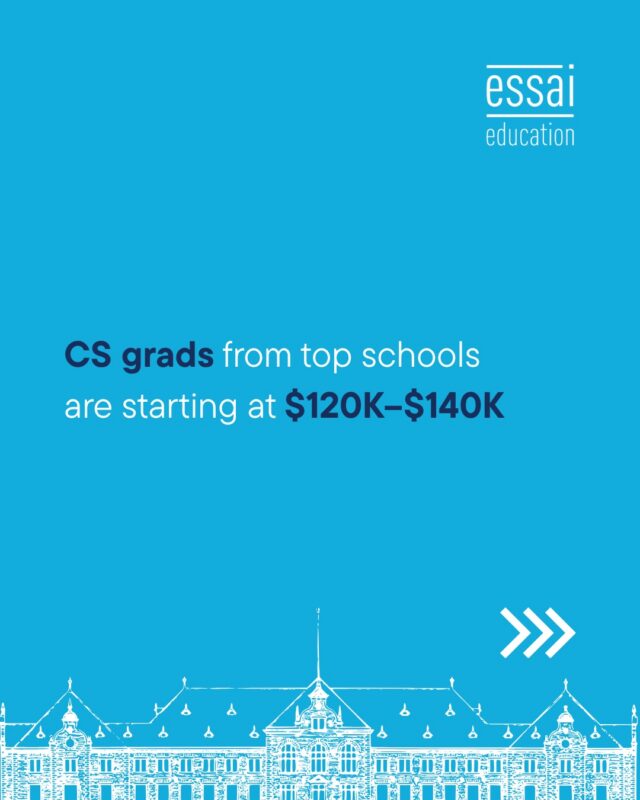
CS pays; everyone knows that. What fewer people notice: across Carnegie Mellon, Penn, and Yale, the median starting salary only moves about $20K ($140K, $130K, $120K).

The school matters less than the work you put in alongside the degree, the internships, the projects, the interview prep.

Aim high, then plan what you'll do once you're in.

Sources (median starting salary, full-time employed grads):
CMU: https://www.cmu.edu/career/outcomes/post-grad-dashboard.html
UPenn: https://careerservices.upenn.edu/post-graduate-outcomes/undergraduate-first-destinations/
Yale: https://ocs.yale.edu/outcomes/

#essaieducation #computerscience #collegeadmissions #studyabroad #careeroutcomes
For more details, email at info@essai.in or call +91 98310 44594, +91 99101 12374, or +91 98102 48912

©2026 ESSAI | Designed by Trigacy