

Are you using AI to apply to Ivy League colleges? If yes, ask yourself: “Is this helping me grow, or just helping me cheat?”
The world of Ivy League college applications is evolving fast.
While the competition is as fierce as ever, students now have access to powerful tools like ChatGPT and AI.
Used correctly, these tools can elevate your application. Used carelessly, they can ruin it.
In this detailed guide, we’ll explore seven ethical, smart, and practical ways to use ChatGPT and AI to improve, not replace, your Ivy League college application.
You’ll also learn what not to do, and how platforms like Essai help you use tech responsibly for maximum impact.
Why Are Students Turning to AI in the Application Process?

1. Overwhelming Pressure and Time Constraints
Applying to Ivy League colleges is famously intense.
Students juggle multiple essays (Common App, supplements), tight deadlines, extracurricular records, recommendation letters, test scores, portfolio materials, and more.
The volume and complexity often overwhelm even the most organized applicants.
AI offers time savings.
Tools like ChatGPT help students brainstorm, outline, and structure their essays, which makes the daunting task of shaping multiple pieces of writing more manageable.
Relief from repetitive tasks. Many parts of college applications, activity descriptions, résumé bullets, and activity lists demand clarity and brevity.
AI can quickly help rephrase, condense, or polish such content.
For ambitious students balancing academics, extracurriculars, and application demands, AI becomes a valuable time-management tool.
2. Assistance with Brainstorming, Structure, and Clarity
Writing a powerful, authentic personal statement, especially one worthy of an Ivy League College application, requires self-reflection, clarity, and strategic storytelling.
Many students struggle with what to write, how to write it, where to start, or how to structure their narrative.
AI tools help address those writing-process bottlenecks:
- Idea generation
- Structural guidance
- Neutral, judgement-free feedback
- Accessibility
In short, AI can scaffold the creative process, but the content, emotion, and authenticity must come from the applicant.
3. Objective, Consistent Feedback and Editing
Human feedback, from teachers, mentors, and friends, is valuable. But it can also be inconsistent, biased, or influenced by mood, priorities, or time constraints.
AI offers a complement: consistent, immediate, impartial support.
- Grammar, clarity, readability
- Baseline consistency
- Safe space for early drafts
This objective support is invaluable when polishing multiple components (essays, activity descriptions, personal statements) under tight deadlines.
4. Democratizing Access, Helping Students Without Expert Guidance
Not every student has access to premium college counseling, professional editors, or mentors who’ve “been there.” AI offers a more accessible alternative: a virtual assistant that’s always on.
- Support for students in remote or underprivileged areas
- Lowering the barrier to entry
- Equalizing chances for non-native English speakers
In effect, AI becomes a “first-draft equalizer,” helping students who might otherwise struggle with writing or clarity to present themselves more strongly.
5. Growing Awareness of What Admissions Teams Actually Look For, and Using AI Responsibly
As admissions standards evolve, many students now realise that top colleges aren’t just looking for perfect grammar or polished prose; they want authenticity, reflection, individuality, and personal growth.
- AI isn’t used to replace voice, but to support it
- Universities themselves are adopting AI in admissions
- Shift toward fairness, consistency, and scale
Students are learning that responsible use of AI, to clarify expression and presentation while preserving authenticity, may give them an edge in a more competitive, AI-aware admissions environment.
Here are the Top 7 Ways to Ethically Use ChatGPT and AI for Ivy League College Applications.
1. Brainstorming Personal Statement Topics (Without Replacing Your Voice)
Your personal statement isn’t about showing off; it’s about showing up as your authentic self. But figuring out what to write is often the most challenging part.
That’s where tools like ChatGPT come in; not to write your story, but to help uncover it.
Use AI to prompt reflection, not replace it. Ask:
- “What themes work well in college essays?”
- “Suggest stories around resilience or curiosity.”
- “Ideas for students who’ve moved schools often?”
These prompts can spark memories or new angles, but only you can decide what truly represents your journey.
Smart Ethical Workflow
- Prompt ideas using AI
- Reflect on what resonates
- Freewrite your real moments
- Connect those moments to who you are today
- Outline your narrative in your own words
Avoid This
- Don’t copy AI-written content
- Don’t choose a topic just to sound impressive
- Don’t over-polish, authenticity beats perfection
2. Structuring Your Essay and Organizing Thoughts

Once you’ve chosen your story, structure turns your idea into a compelling narrative. An excellent essay isn’t just what you say, it’s how you say it.
ChatGPT can help you sketch a structure, not write the essay. Try prompts like:
- “Outline an essay about overcoming fear.”
- “Structure an essay about identity and change.”
AI might suggest formats like:
- Hook → Challenge → Growth → Reflection
- Past → Turning Point → Present → Future
These templates help organize your thoughts, but they’re just starting points.
How to Use It Well
- Draft your story freely
- Ask AI to suggest flow or transitions
- Adjust the order to match your voice and rhythm
- Keep the emotional arc true to your experience
Avoid This
- Don’t force your story into a rigid AI structure
- Don’t let transitions sound robotic
- Don’t over-edit the “realness” out of your voice
3. Enhancing Grammar, Style, and Readability

Once your draft is ready, it’s time to polish, and that’s where AI tools like ChatGPT shine. Think of them as editors, not co-authors.
Use AI to catch what you might miss:
- Grammar slips and awkward phrasing
- Passive voice and repetitive words
- Clunky transitions between ideas
Prompt example:
“Improve clarity and grammar without changing my tone.”
This keeps your voice intact while making your writing smoother and more readable.
How to Use It Well
- Write your full draft first
- Run it through ChatGPT for suggestions
- Review every change, don’t blindly accept edits
- Make sure the tone still sounds like you
Avoid This
- Don’t ask AI to “make it sound Ivy League”
- Don’t rewrite full paragraphs unless it’s still in your voice
- Don’t submit anything AI-polished without reviewing it closely
4. Clarifying Complex College Prompts

Some Ivy League supplements are tough to decode.
Questions like “What does community mean to you?” or “Discuss a book that shaped your worldview” can feel vague or intimidating.
ChatGPT can help you unpack them. Try prompts like:
- “Explain what Yale means by ‘intellectual curiosity.’”
- “What’s the difference between a leadership and impact essay?”
AI can break down the intent, suggest examples, and help you avoid misinterpreting the question.
How to Use It Well
- Paste the prompt into ChatGPT
- Ask for a simpler explanation or context
- Use its feedback to frame your own answer
- Brainstorm real stories that respond authentically
Avoid This
- Don’t use AI to generate the full essay
- Don’t lift sample responses, they’re generic and detectable
- Don’t miss the core question behind the words
5. Practicing Interview Questions with ChatGPT

Interviews can be stressful, but preparation builds confidence.
ChatGPT can help simulate Ivy League-style interviews so you can practice anytime, anywhere.
Use prompts like:
- “Act as a Harvard interviewer and ask me 5 questions.”
- “Give feedback on my answer to: ‘Tell me about yourself.’”
AI can help you refine your answers, improve structure, and sound more reflective, without memorizing scripts.
How to Use It Well
- Practice speaking your answers out loud
- Ask AI to critique clarity and depth
- Focus on expressing values and experiences
- Tweak your delivery to feel natural and sincere
Avoid This
- Don’t memorize AI-written responses
- Don’t try to sound overly polished
- Don’t treat it like a test, be conversational
6. Managing Application Timelines and Checklists

The Ivy League application process includes essays, tests, supplements, recommendation letters, financial aid, and more, each with its own deadline. It’s easy to miss something.
ChatGPT can help you stay organized.
Prompt examples:
- “Create a timeline for applying to Harvard, Yale, and Princeton.”
- “Make a checklist of what’s due for the Common App.”
AI can break things down by week or month, helping you plan and track tasks efficiently.
How to Use It Well
- Ask for deadlines by school (but double-check them!)
- Use AI to structure your to-do list
- Set reminders or milestones for each stage
- Revisit your list weekly to stay on track
Avoid This
- Don’t rely on AI for actual dates, verify them
- Don’t skip backup planning (like teacher follow-ups)
- Don’t wait until the last minute, even with a checklist
7. Refining Activity Lists and Resume Descriptions

The Common App gives you just 150 characters to describe each activity, that’s not a lot of space to show impact. But clarity and strong verbs can make a big difference.
ChatGPT can help tighten your descriptions.
Prompt example: “Rewrite this activity in 150 characters: ‘Organized school blood drive and recruited volunteers, resulting in record participation.’”
AI might return: “Led blood drive, coordinated team of 12, achieved highest turnout in school history.”
This keeps your writing concise, results-focused, and action-driven.
How to Use It Well
- Write your version first
- Ask AI to suggest shorter, stronger phrasing
- Keep only what reflects real impact
- Personalize edits to sound like you
Avoid This
- Don’t inflate roles or results
- Don’t use generic or flashy verbs that don’t match your tone
- Don’t submit anything you wouldn’t say out loud
How Are College Students Really Using AI Tools? Here’s What the Data Shows
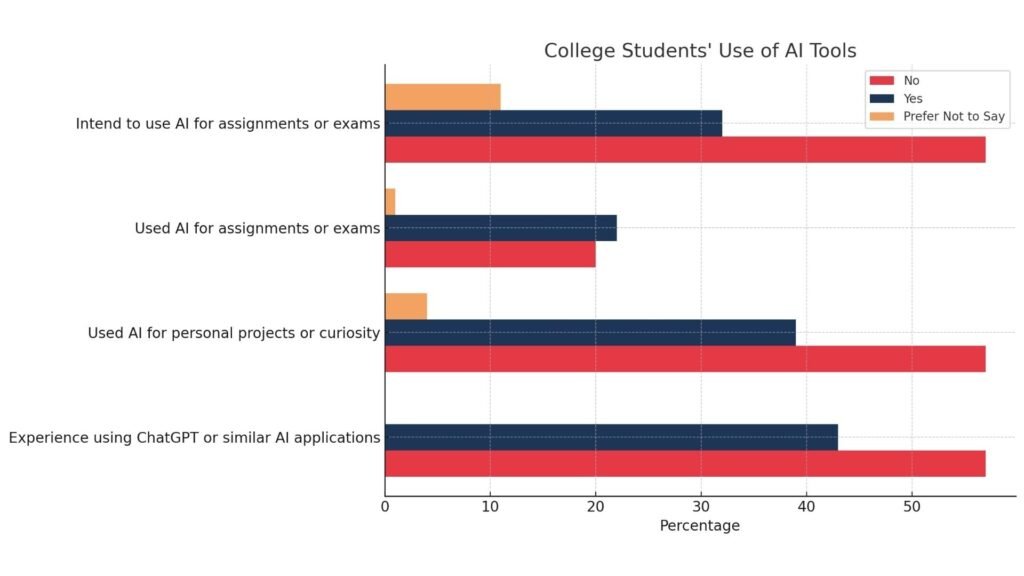
The rise of AI tools like ChatGPT has sparked both excitement and debate in the world of college admissions.
But beyond speculation, recent data reveals how students are actually integrating these tools into their application process.
Over 50% of students report using AI tools primarily for idea generation.
Instead of writing complete essays, they use platforms like ChatGPT to brainstorm topics, explore themes, or clarify how to structure their narratives.
The second most common use is for grammar and language refinement.
Students leverage AI to proofread, improve sentence flow, and enhance clarity while keeping their original voice intact.
Another significant use is for structural guidance.
Students ask AI for feedback on how to organize their points, improve transitions, or build a compelling introduction and conclusion.
Only a small minority admits to writing entire essays with AI, a practice most institutions discourage.
Interestingly, the trend shows a growing awareness of ethical AI use, with students recognizing that AI should act as a thinking partner rather than a shortcut.
This data highlights a shift toward responsible integration of technology in the application process.
When used correctly, AI helps students express their ideas more effectively without compromising authenticity.
This balance between support and over-reliance is essential. The goal isn’t to avoid AI entirely, but to use it thoughtfully to enhance, not replace, one’s own voice.
What NOT to Do: Unethical Uses of AI
While AI tools like ChatGPT can support your Ivy League application, using them the wrong way can seriously harm your chances.
Here’s what crosses ethical boundaries:
- Asking AI to write your entire personal statement or supplement
- Copying AI-generated content with little to no editing
- Letting AI exaggerate or invent achievements
- Using ChatGPT to complete take-home tests or writing assignments
Why This Is a Problem
- Most top colleges use AI and plagiarism detectors
- Essays that sound generic or over-edited raise suspicion
- Inauthentic applications risk rejection, even if the facts are accurate
AI should never replace your thoughts, experiences, or voice. If your story doesn’t feel like you, admissions officers will notice.
Essai’s Advice: Use AI to support your process, never to impersonate you. The best applications are honest, thoughtful, and unmistakably real.
Why Ethical Use of ChatGPT & AI Gives You an Edge?
AI can’t get you into an Ivy League school, but using it the right way can absolutely give you an advantage.
When used ethically, ChatGPT and similar tools enhance clarity, confidence, and focus without compromising originality. They help you become a better applicant, not just a faster one.
1. You Save Time Without Sacrificing Authenticity
Ethical AI use lets you spend less time staring at a blank page and more time refining ideas that actually reflect who you are.
By outsourcing structure, grammar, and organization support (not content creation), you get more mental space to focus on what matters: your voice and your growth story.
2. You Build Self-Awareness Through Reflection
AI can prompt you with questions you might not have thought to ask yourself:
- What’s a challenge that helped shape your worldview?
- What values show up across your extracurriculars?
This kind of digital dialogue can guide reflection and help uncover hidden connections between your experiences and goals, but only if you do the answering.
3. You Demonstrate Maturity and Resourcefulness
Admissions teams aren’t naive. They know students are experimenting with AI. What matters is how you use it.
Ethically using AI for editing, brainstorming, outlining, and organizing shows maturity, digital literacy, and initiative.
You’re showing that you understand boundaries, take ownership of your voice, and know how to use modern tools responsibly.
4. You Produce Cleaner, More Readable Applications
Using AI to review grammar, streamline sentence structure, and organize your timelines or checklists results in more transparent communication, which admissions officers appreciate.
When your application is free from distractions like typos or confusing structure, your story stands out more.
5. You Stand Out Without Sounding Scripted
The best essays are not the most polished; they’re the most honest. Ethical AI use helps you enhance your writing without flattening your personality.
The result? Applications that feel focused, confident, and real, something that resonates deeply with readers.
How Essai Helps Students?
At Essai, we believe that every student has a story worth telling, and our mission is to help you tell it with clarity, confidence, and integrity.
We don’t just edit essays; we guide students through every stage of the Ivy League application journey.
From brainstorming authentic topics to refining structure, tone, and impact, we combine expert mentorship with innovative tools to support your growth.
Our approach emphasizes ethical, student-driven storytelling. We teach you how to use AI the right way, as a support tool, not a shortcut, so your voice remains at the heart of your application.
Whether you’re feeling stuck, overwhelmed, or unsure how to stand out, Essai offers the structure, strategy, and feedback you need to succeed, without losing what makes you unique.
Because at Essai, it’s not about writing a perfect application. It’s about helping you discover and deliver your best one.
Conclusion
As the college admissions landscape evolves, so too must the tools students use to navigate it.
ChatGPT and other AI platforms offer powerful support, from organizing thoughts to refining grammar, but they are not a substitute for your own story, effort, and authenticity.
Admissions officers are looking for you, your experiences, your voice, and your growth. AI can help sharpen how you present those things, but it cannot (and should not) invent them for you.
Used ethically, AI becomes a creative partner. Misused, it risks undermining everything you’ve worked hard to achieve.
The difference lies not in the tool itself, but in how you choose to engage with it.
Own your journey. Let AI enhance it, not define it.
FAQs
Q. Can Ivy League colleges detect AI-generated content?
A: Yes. Many use detection tools. Essays that sound too generic, formulaic, or inconsistent with your other materials can raise red flags.
Q. What’s considered ethical vs unethical use of ChatGPT?
A: Ethical: brainstorming, grammar checks, outline suggestions. Unethical: generating complete essays, copying AI text, and lying about experiences.
Q. Is it okay to use ChatGPT to prepare for interviews?
A: Yes, if you use it for mock practice. Avoid memorizing word-for-word AI-generated answers.